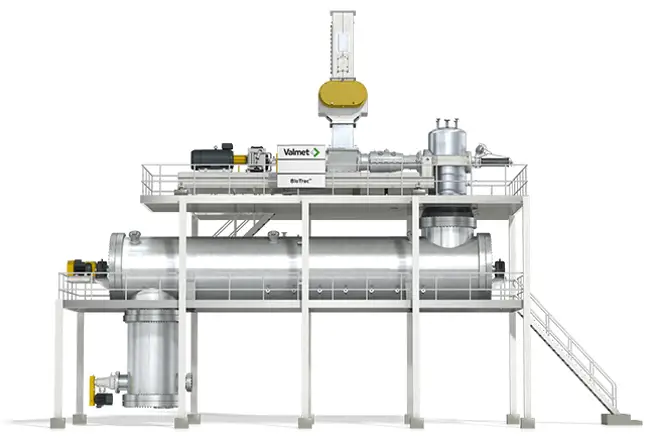
Valmet debuts at Bio-based 2026 with the pretreatment BioTrac
As the 11th Bio-based Industry Conference & Exhibition grandly took place at Shanghai Fuyue Hotel from May 20 to 22, 2026, themed Surpassing the New Cycle, Forging Vital New Opportunities. The conference focused on key sectors including bio-based materials, biomanufacturing, green fuels, cellulose, lignin and non-food biomass utilization, attracting over 1,000 participants.

As a partner of the forum, Per Norlin and Hu Jinxin, Sales Managers of Pulp, Energy and Circularity at Valmet, delivered a keynote speech at the Key Chemicals and Materials Forum, titled “Continuous Steam Explosion Pretreatment Technology for Biomass Refining – Valmet BioTrac Solutions and Case Studies.”

Per Norlin (left photo) and Hu Jinxin (right photo).
Valmet advances from pulp and paper into biorefining
With long-accumulated technological expertise and engineering experience in the global pulp & paper, energy and process industries, Valmet has built core advantages in fiber processing, continuous cooking, heat integration, automatic control, equipment reliability assurance and EPC execution of large-scale projects. On this basis, the company has extended its proven engineering capabilities to the field of non-food biomass resource utilization.
Responding to industrial development trends, Valmet launched the pretreatment technology, BioTrac. It provides an integrated, scalable and engineering-amplifiable pretreatment solution for lignocellulosic biomass such as straw, wood chips, bamboo, bagasse and energy grass, accelerating the biomass refining industry from laboratory verification to large-scale industrial implementation.
Per Norlin presenting the Valmet pretreatment, BioTrac system.
Pulping process vs steam explosion process
One highlight of the speech is defining the applicable boundary of the two processes in biomass refining. The traditional pulping process targets high-purity cellulose pulp for papermaking and dissolving pulp, focusing on oxygen delignification and fiber purification, which is suitable for papermaking and cellulose-based material production. However, when applied to produce fermentable sugar, fuel ethanol, SAF precursors or bio-based platform chemicals, excessive pursuit of pulp purity will drive up process costs, cause loss of hemicellulose carbon sources and result in poor economic benefits.
The core of Valmet BioTrac pretreatment technology is to disrupt the dense structure of lignocellulose, improve enzymatic hydrolysis efficiency, and fully retain C5/C6 sugar components. Featuring zero chemical dosage and streamlined process flow, it efficiently converts non-food biomass into fermentable sugar liquor for further processing into green fuels, bio-based materials and biochemicals.
From an industrial perspective: the traditional pulping process is preferred for high-grade fiber pulp production, while the continuous steam explosion process delivers superior economic performance for low-cost mixed sugar preparation and downstream bio-based product development.
Valmet Pretreatment system, BioTrac, tailored for industrialization
Valmet Pretreatment Technology is a customized continuous pretreatment system exclusively developed for non-food biomass refining. By precise steam supply, pressure stabilization control and continuous material discharge, combined with thermochemical effects and mechanical shearing, it disrupts the dense structure of biomass and greatly improves subsequent enzymatic hydrolysis efficiency, stably supplying fermentable mixed sugar raw materials for mixed sugar platform, cellulosic ethanol, bio-based chemicals and new bio-based materials.
Up to now, Valmet has deployed 28 sets of BioTrac projects worldwide, covering diverse application scenarios including bio-based chemicals, cellulosic ethanol, biomass solid fuel, molded pulp, MDF recycling and biomethane. It has fully verified the technology’s adaptability to multiple raw materials and processes, providing a mature engineering benchmark for the industrialization of non-food biomass refining in China.
Valmet combines global expertise with local delivery and services in China
To meet the rapid development demand of China’s bio-based industry, Valmet has built a full-chain service system integrating global technical support and local project delivery, helping domestic customers complete the whole process from raw material testing and process verification to engineering implementation, and effectively reducing project R&D and industrialization risks.
Relying on its Fiber Technology Center in Sweden, Valmet carries out customized adaptation tests, steam explosion experiments and process development for local non-food raw materials such as straw and wood chips, providing professional technical demonstration and customized solutions based on real raw material test data.
In China, Valmet has deployed 7 manufacturing bases and 5 service centers, providing full-life cycle exclusive services for Chinese customers in equipment manufacturing, EPC contracting, installation & commissioning, operation & maintenance, spare parts supply and long-term technical support.
Partner with Chinese customers to build a green and low-carbon future
With the in-depth advancement of China’s dual carbon strategy, green fuel, bio-based material and degradable packaging industries have achieved explosive growth, and the efficient resource utilization of non-food biomass has become a strategic industry priority. Industrial conversion technologies with low cost, low carbon emission and high stability have become the core competitive focus of the bio-based industry.
Looking ahead, Valmet will continue to deepen technological R&D and innovation. Supported by core process technologies, it will cooperate with domestic enterprises, research institutions and industrial chain partners to empower the transformation and upgrading of the bio-based industry and contribute strong engineering momentum to the realization of China’s dual carbon goals and national green low-carbon transition.