
Strong collaboration brings Metsä Tissue’s Future Mill to life
At Metsä Tissue’s Future Mill in Mariestad, Sweden, a new tissue production line has become a central part of the expanded and modernized mill. The project brings together tissue making, converting, tissue machinery automation, training and lifecycle support in an integrated Valmet delivery.

After several years of planning, engineering and close cooperation, the investment is now delivering results. For the people involved, seeing the project come to life has been both professionally rewarding and personally meaningful.

“The feeling is great. You see something you have worked on for several years come to life. We have built something that will stay here and provide a foundation for future business.”
Esa Paavolainen,
Vice President of Technology, Metsä Tissue
A major investment in Mariestad, Sweden
The Future Mill represents a major investment in the continued development of Metsä Tissue’s Mariestad mill. The €370 million investment has increased the mill’s annual tissue production capacity to approximately 145,000 tonnes and includes a new tissue machine, three converting lines and a fully automated warehouse.
Valmet’s scope covered a substantial part of the new production flow, from stock preparation and tissue making to tissue machinery automation, converting and packaging.

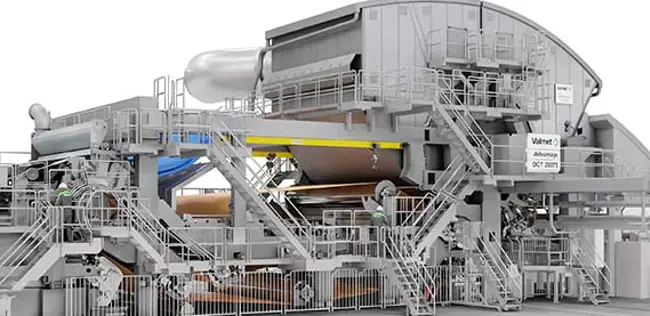
The Valmet Advantage™ DCT200TS tissue machine has a design speed of 2,200 m/min
Connecting tissue making and converting
Valmet’s delivery provides an opportunity to connect processes that have traditionally been managed separately and use data to better understand the relationship between tissue making and converting.
“Being able to provide both paper production and converting machinery is an important part of the future of the tissue business. It enables communication between the machines and allows data analysis and data management to connect the processes,” says Paavolainen.

The Valmet Perini Constellation S8 converting lines offer flexibility to manage different product specifications and formats.
One example is the Digital JumboRoll concept, which helps connect tissue making and converting through data-driven process optimization.

“The Digital JumboRoll concept connects converting and tissue making, giving us better insight into where improvements are needed and how converting performance can support optimization of the paper machine.”
Sakari Pentti,
Technology Manager, Metsä Tissue.
Safety, ergonomics and efficient operations
The automatic bale handling and de-wiring system was another important element of the investment, designed to improve safety and ergonomics while increasing process control.
“The automatic bale handling solution offers clear safety and ergonomic benefits. It also enables us to track bale consumption and make sure that the right bales reach the right destination,” says Pentti.
Cooperation throughout the project
According to Metsä Tissue, close cooperation between the project teams played an important role throughout the project, from engineering and manufacturing to installation, training and commissioning.
Pentti on the collaboration:
The cooperation with Valmet has generally been very good. "Valmet had specialists covering several disciplines, including civil works, electrical systems and instrumentation."
As with many large industrial investments, the project faced changing circumstances during implementation. Metsä Tissue highlighted Valmet’s ability to adapt when installation sequences had to be modified. “You were also able to adapt to delays and changes in the installation order very well,” notes Pentti.
Training supports a smooth start-up
Preparing operators for a completely new production environment was a key element of the project. Valmet provided an extensive training package covering different process areas and supported the start-up with substantial on-site resources.
“We had an extensive training package covering the different process parts. One of the main advantages was that Valmet was able to provide much of the training in Swedish, helping operators learn and prepare in their native language,” says Pentti. During start-up, the operators were able to put this preparation into practice “There were many new things to learn, but very few issues arose, and those were solved together with the Valmet specialists on site.”
Despite the complexity of the project and the amount of new equipment introduced, the start-up was completed successfully.
|
Valmet's delivery to Metsä Tissue's Future Mill |
|
Early results meeting expectations
Now that the line is operating, Metsä Tissue is already seeing encouraging results. “First of all, the OEE development of the paper machine has been according to our expectations, or even a bit faster. We have reached our targets for the paper machine,” says Paavolainen.
The quality improvements have also stood out as he continues:
The quality profiles produced by today’s machines are on a completely different level compared to older machinery. We can clearly see from the uniformity of the web that the machine is capable of producing excellent material.”
While optimization work continues, particularly between tissue making and converting, the overall results have been positive. “We still have things to learn about making the best paper for converting, but overall we are happy with the results,” says Paavolainen.

Building for the future
As the Future Mill continues to ramp up, both companies see the project as the foundation for future development. The start-up demonstrates what can be achieved when technology, services, training and close cooperation are combined within a single project.
“There was a good cooperation throughout the project. We have had an excellent dialogue on many different topics. It has not always been completely smooth, which is natural in a project of this size, but it has created a strong foundation for our future relationship, especially now that Valmet can provide a broad end-to-end solution,” concludes Paavolainen.



More tissue insights and news
Explore more insights and customer stories from the industry


